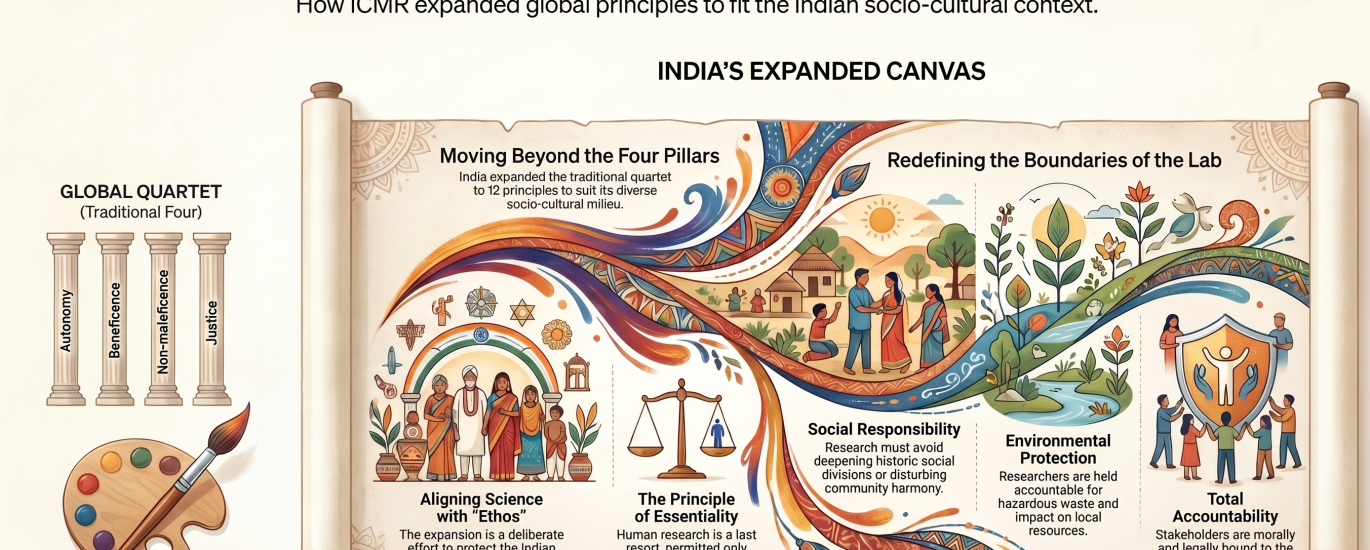
While the international research community typically anchors itself to four cornerstone principles—Autonomy, Beneficence, Non-maleficence, and Justice—India has found this quartet insufficient for its “diverse socio-cultural milieu.” In what bioethicists often refer to as the “Dirty Dozen,” the ICMR has expanded these into 12 General Principles. This is not merely bureaucratic bloat; it is a deliberate effort to align scientific inquiry with the “ethos” of the Indian population. Three of these principles redefine the traditional boundaries of a lab: Essentiality: Research involving humans is not a first resort. It is only permitted after every alternative has been exhausted and the study is vetted as absolutely necessary. Social Responsibility: Research must be designed to ensure it does not deepen historic social divisions or disturb the harmony of the community. Environmental Protection: In a surprising but necessary technical addition, researchers are held accountable for the impact of their work on the environment, particularly regarding the disposal of hazardous biological waste and the strain on local resources.
“Every advance in medical science results in added moral responsibility.”