The scale of biomedical and health research in India is currently unprecedented. Across the nation’s medical institutions, research centers, and universities, thousands of complex studies are active at any given moment. While participants and the public primarily interact with front-line clinicians and innovative treatments, the true integrity of this ecosystem is maintained by a silent, high-stakes governance mechanism: the Ethics Committee (EC). These committees are not mere bureaucratic hurdles; they are the primary guardians of institutional risk and public trust.
To the average participant, the Ethics Committee remains invisible—a silent board that has meticulously scrutinized thousands of pages of data, protocols, and safety profiles long before a single patient enters a clinic. They serve as the essential infrastructure that ensures scientific ambition never outpaces human safety. In a field where the pressure to innovate is immense, who ensures that the person remains the priority?
Ethics is a Marathon, Not a Sprint
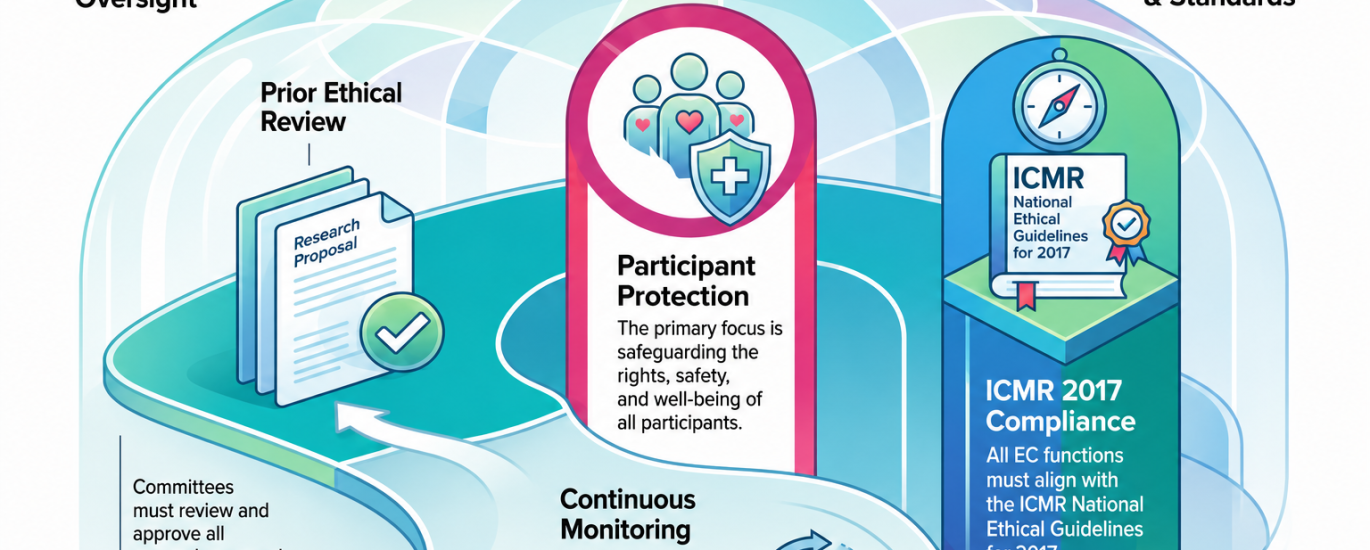
From a compliance and strategic perspective, ethical oversight is not a “check-the-box” activity performed only at a study’s inception. The source context makes it clear: Ethics Committees hold a “continuing responsibility” to monitor research throughout its entire lifecycle. This means the EC must regularly audit approved research to ensure ongoing compliance during the actual conduct of the study.
This longitudinal oversight is a critical risk mitigation strategy. Research is not a static event; participant health status can change, and unforeseen side effects may emerge as a study progresses. Continuous monitoring allows for the dynamic assessment of risk, protecting the institution from liability and the participant from evolving hazards that were not present on Day 1. It transforms ethics from a static approval into an active, protective process.
The Core Mandate: People Over Protocols
While researchers are often incentivized to focus on data points and protocol adherence, the Ethics Committee serves as the institutional moral compass, shifting the focus back to the individual. The duration of oversight is only as effective as its primary objective: the protection of the human subject.
The mandate is explicit:
“Ethics Committees (EC) are entrusted with the responsibility to… ensure that the rights, safety and well-being of research participants is protected.”
This human-centric focus is the non-negotiable infrastructure of modern medicine. By centering the “rights, safety, and well-being” of the participant, the EC ensures that the drive for medical breakthroughs is always balanced against the fundamental necessity of human protection. For a strategist, this is about maintaining the “social license” to operate; without this trust, the entire research enterprise would collapse.
The Rulebook for Innovation: The ICMR 2017 Standard
To maintain consistency across India’s diverse research landscape, Ethics Committees do not operate on subjective intuition. They are governed by a rigorous regulatory framework: the ICMR National Ethical Guidelines for Biomedical and Health Research Involving Human Participants, 2017. This document serves as the definitive standard for how committees must be constituted and how they must function.
Having a unified national guideline is vital for interoperability and the standard of care. It allows for multi-center studies to occur across different universities and hospitals without conflicting ethical benchmarks. By establishing a high “floor” for safety and conduct, the ICMR 2017 guidelines ensure that whether a study happens in a major metropolitan hospital or a specialized research center, the ethical protections remain uniform. This standardization is what accelerates medical progress while keeping the national research ecosystem secure and credible.
Conclusion
Ethics Committees are the essential architects of integrity in health research, providing both the initial gatekeeping and the rigorous, ongoing monitoring required to safeguard human life. They ensure that the pursuit of knowledge is never decoupled from the rights of the individual. As we move toward a future of increasingly complex medical breakthroughs, we must ask: how does the transparency and strength of these ethical processes influence your own willingness to participate in the science of tomorrow?
Final Takeaway: In the race for innovation, Ethics Committees ensure that human dignity is the finish line, not a hurdle.